A child who will always need care: the trust, the will and the home
A government taskforce has named the Special Needs Trust, the will and deputyship as steps to take early, and I think the home belongs in that conversation too.
By Jessin Chua

As the Ministry of Social and Family Development announced on 4 October 2026, the Taskforce on Assurance for Families with Persons with Disabilities has released its recommendations. Its report sets out three shifts. The first, Planning for the Future, introduces Future Care Planning support, which will be made available progressively across adult disability services from 2027 onwards. The same report widens the means-tested subsidies for adult disability services, and aims to have the new affordability measures in place by 2028.
Most of the attention will rightly go to services, jobs and fees. I read one passage more slowly than the rest. In its section on finances, the report names SG Enable's Special Needs Trust in the same sentence as will writing and applying for deputyship. It is a plain sentence. For a family with a child who will always need care, it is close to the whole of estate planning.
What did the taskforce hear from families?
The Taskforce engaged more than 200 people, including persons with disabilities, caregivers, employers and agencies. Families described a "post-18 cliff", the uncertainty that arrives when a young person leaves a Special Education school. The report also records a quieter worry. Many caregivers, it says, worried about what would happen to their child when they were no longer able to care for them, and were unsure what decisions or preparations they should be making. The demands of daily caregiving left them little time to think about the longer term.
One caregiver put it in words the report prints in full: "There's no option to plan so we [are] sort of stuck. So, we just live [on] a day-to-day basis."
Future Care Planning is the report's answer. Care planners will work with a person with disabilities and their family to understand their goals, think through situations they may not have considered, and connect them with services. Each plan is meant to cover five areas of life: meaningful engagement, financial, housing and daily living, relationships, and medical and healthcare. The report calls it a living document, updated whenever circumstances change, that follows the person through life.
What does a Special Needs Trust actually do?
The report describes a Special Needs Trust account as a way to provide financial support for a person with disabilities in the future, especially when caregivers pass on. With a minimum sum of $5,000, caregivers can set up an account through the Special Needs Trust Company, a fully owned subsidiary of SG Enable. SG Enable's Case Managers help caregivers work out how much to set aside, and the company manages and uses the funds according to the caregiver's wishes. On its own page, SG Enable describes the company as a not-for-profit trust company, a registered charity and a partner of the Public Trustee's Office.
The report also points to GOAL+, which offers eligible families a $5,000 ComChest sponsorship to start a trust account, plus dollar-for-dollar government matching of up to $10,000 in contributions over five years. It runs from 1 April 2026 to 31 March 2031. Some schemes like this are time-limited, and the report's own observation is that families who plan ahead are better placed to make full use of them.
What I notice is what the trust is for. It is not a way to grow a sum. It answers a narrower question: who will hold the money for my child, and spend it as I would have, once I am not here to do it. That is a question of stewardship, and it is best asked while the parents can still answer it themselves.
A trust answers who will hold the money. A will answers what passes to whom. Neither, on its own, answers who will decide.
Why do a will, an LPA and deputyship all come up?
Because each does a different job, and the gaps between them matter more in these families than in most. The Deputyship Guide from the Office of the Public Guardian sets them side by side. A will states how your money and possessions are shared after you pass away, and takes effect only then. A Lasting Power of Attorney, or LPA, is made by someone who still has mental capacity, to choose who will act for them if they lose it. Deputyship is for someone who has already lost mental capacity and did not make an LPA. In that case, a person applies to the court to be appointed as a deputy to act on their behalf.
An LPA, then, has to come from the person it protects, while they have capacity. Where a grown child lacks that capacity and has no LPA, the guide's answer is deputyship. The Office of the Public Guardian notes that parents may apply to court to appoint themselves as deputies for their children who lack mental capacity. An individual deputy must be 21 or older. A deputy acts within the powers in the court order, which may cover personal welfare and property and affairs, must decide in the person's best interests, and reports to the Office of the Public Guardian.
Two details are worth holding on to. A successor deputy may be appointed for when the deputies cannot act, because they have lost mental capacity themselves or have died. And the guide notes that a will does not cover decisions made during your lifetime, which is why it calls an LPA important too. That applies to the parents' own planning as much as to their child's. I would want both looked at together: the parents' will and LPA, and the arrangements for the child.
These are legal instruments with lasting effects. The drafting belongs with a lawyer who can see the family's full position.
Where do the new subsidies stop?
The affordability measures are substantial. Today, persons with disabilities in services such as residential homes and community services receive means-tested subsidies if their per capita household income is $4,800 or less. MSF is extending that to around $6,000, which the report says covers about 80% of households of persons with disabilities, up from about 70% today. The report sets out higher means-tested subsidies, by at least 10 percentage points for most families, and a cap on fees after subsidies for all disability services. For families of persons with higher support needs, it gives monthly fees for selected services about 25% to 80% below today's.
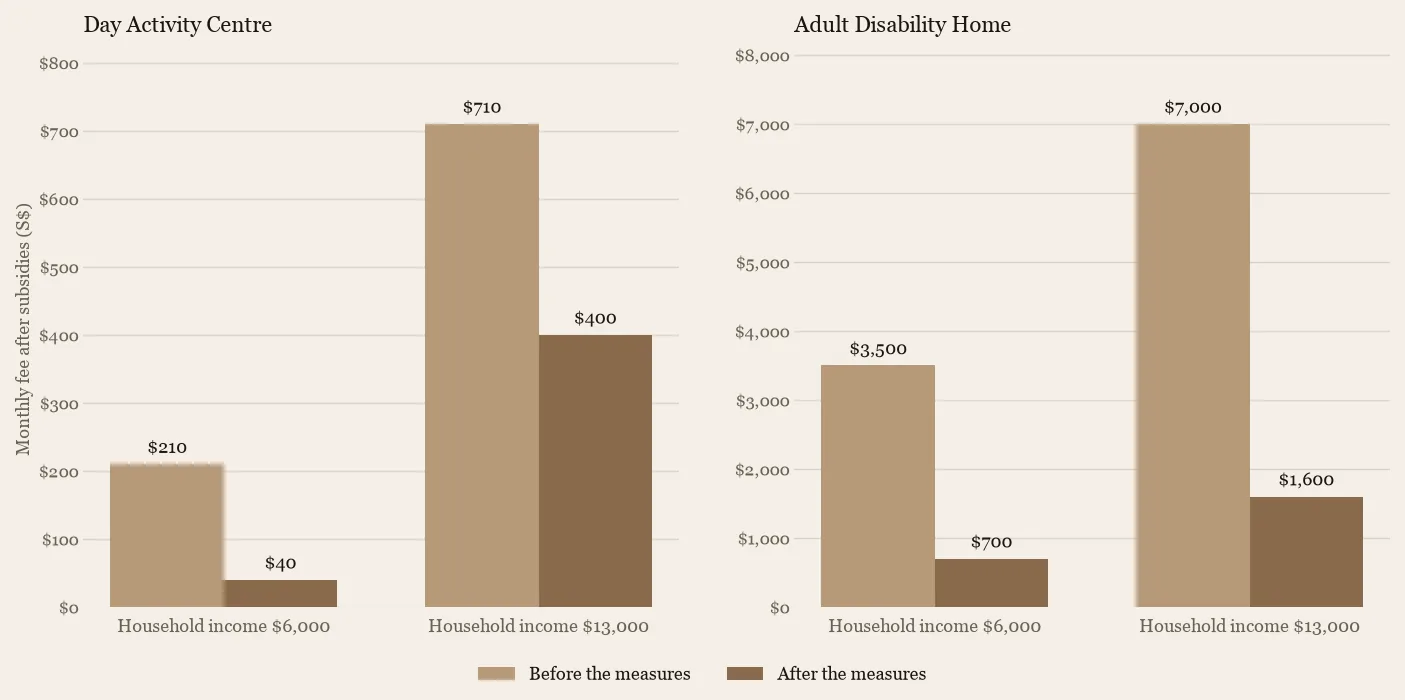
The report's example is a four-person family in an HDB flat, caring for a person with higher support needs. On a household income of $6,000, its table shows a place at an Adult Disability Home at $3,500 a month before the measures and $700 after. On $13,000, the figures are $7,000 before and $1,600 after.
Those are real reductions, and I would not want to understate them. But a ceiling is still a ceiling. On the report's own figure of about 80%, the rest of these households sit above it. The report is direct about why the costs weigh so heavily: disability-related care needs are lifelong, and persons with disabilities often have limited or no personal income and savings to draw on. For a family above the line, the trust, the will and the home are the plan.
Where does the home fit in?
For many families, I think the home is the largest thing they own, and the hardest to leave to someone who cannot manage it. A home asks for decisions: who lives in it, who looks after it, whether it is let or sold. If it passes to a grown child who lacks capacity, someone will need the authority to make those decisions, and a deputy's powers over property and affairs are only what the court order allows.
The report treats housing as one of its five planning areas. Care planners will help persons with disabilities who wish to live independently walk through their housing options and the steps needed to get there. So the question for parents is not only what they leave, but where their child will live, and with whom, and how that sits with the home they hold today.
Whether a home should pass directly, be sold, or be held in some other structure is a decision for the family with a lawyer, and it turns on details an article cannot see. What I would ask is that the home is part of the conversation from the start, alongside the trust and the will, rather than an afterthought to both.

What is worth doing now?
None of this needs to be hurried. A few quiet steps are worth taking in good time:
- Write down, once, who would care for your child and where they would live if you could not. A care plan will need that starting point.
- Ask SG Enable about the Special Needs Trust, and whether GOAL+ applies to your family. The report gives futurecareplanning@sgenable.sg for an appointment with a Case Manager.
- Look at your own will and LPA alongside any trust, so that each points the same way.
- If your child is an adult who lacks mental capacity, ask a lawyer about deputyship, and about a successor deputy.
- Ask an adviser how a CPF nomination sits beside the trust and the will in your family's plan.
The report hopes that no family will have to navigate the future alone. I would add one thing. The earlier the conversation begins, the more of it the parents get to decide themselves.
If this touches your own home
I am glad to talk it through. Property is my side of the table, and I work with Summit Planners, who draw up wills and lasting powers of attorney around the home under their own arrangements.
Start a conversationJessin Chua, CEA R066020B · Isaac Tan, CEA R071233B · PropNex Realty Pte Ltd, CEA L3008022J
Sources
- Taskforce Unveils Three Key Shifts to Strengthen Support for Persons with Disabilities and Their Families Across Life Stages, Ministry of Social and Family Development, 2026-10-04
- Report of the Taskforce on Assurance for Families with Persons with Disabilities, Ministry of Social and Family Development, 2026-10-04
- About Special Needs Trust, SG Enable, Accessed 2026-11-09
- Deputyship for Persons Lacking Mental Capacity, Office of the Public Guardian, MSF, Accessed 2026-11-09
- Deputyship Guide: Caring for a loved one who lacks mental capacity?, Office of the Public Guardian, MSF, Accessed 2026-11-09
- Community Integration: Enabling Village, SG Enable, Accessed 2026-11-09
General information only, correct to my reading of these sources on the date above. Nothing here is financial, legal or tax advice, and none of it takes your circumstances into account. Photographs and charts in this note are credited where they appear.
Jessin Chua · PropNex Realty Pte Ltd · CEA Registration Number R066020B · CEA Licence Number L3008022J