More families now qualify for legal aid, and probate is one of its most common cases
MinLaw has raised the civil legal aid income limit to $1,650 per person, and probate sits among its three most common cases, which says something about how estates are left.
By Jessin Chua

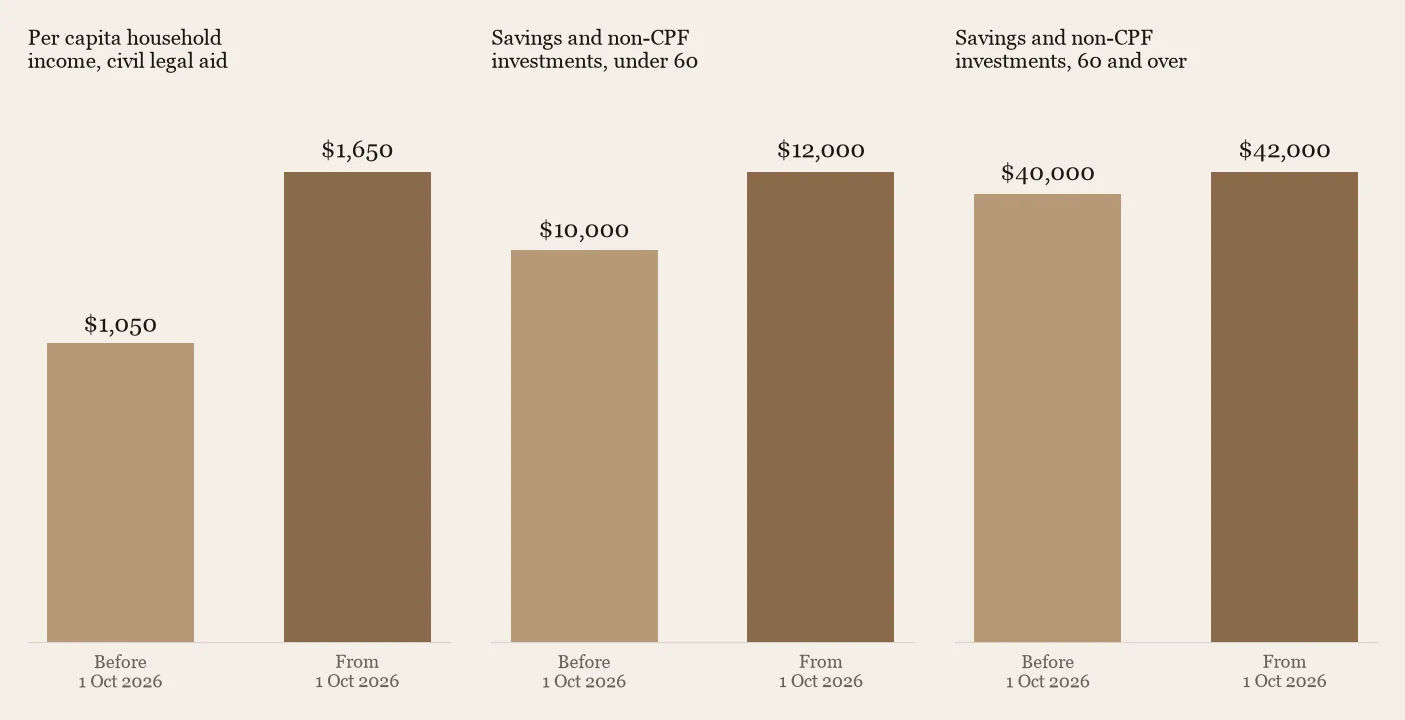
As The Straits Times reported on 30 September 2026, more lower-income Singapore residents can now get legal help. From 1 October 2026, the income limit for civil legal aid rose from $1,050 to $1,650 per person in the household. The Ministry of Law said that up to 1,000 more Singapore Citizens and Permanent Residents are expected to benefit each year. It also named the three most common kinds of civil legal aid case: matrimonial matters, monetary claims and probate matters.
The first two are no surprise. The third is the one I keep returning to. Probate is the work that begins after someone has died, when a family must show who has the right to deal with what was left behind. That it sits in the top three tells me how often an estate is left for the family to sort out after the fact, and how much of that work falls on people with the least room to absorb it.
So this is not really a note about legal aid. It is about two quieter things. An older relative of modest means may now qualify for help that was out of reach before 1 October. And a clear will, a clear title and a few simple nominations help keep the work after a death small, for any family, whatever its means.
What exactly changed on 1 October?
Three limits moved. Civil legal aid is means-tested, and the first measure is income. The per capita household income limit for civil legal aid went from $1,050 to $1,650. According to The Straits Times, this brings it in line with the limit already used for criminal defence aid.
The second measure is savings. The limit on bank savings and non-CPF investments rose from $10,000 to $12,000 for applicants below 60, and from $40,000 to $42,000 for those aged 60 and above. These two limits apply to both civil legal aid and criminal defence aid.
The changes were first announced at the Committee of Supply debates in March. Senior Parliamentary Secretary for Law Eric Chua said then that the savings limit was raised to account for rising household incomes. MinLaw notes that the income limit was also adjusted in 2022 and 2024, and that it will continue to review the thresholds regularly.
Passing the means test is not the end of it. Applicants must also pass a merits test, which the Legal Aid Bureau describes as a check of whether the applicant has a reasonable case to bring or defend in court. Applicants with extenuating circumstances will continue to be reviewed by an independent panel of legal and social service professionals.
Why does probate sit among the most common cases?
When someone dies, another person has to be given the authority to deal with what they left. The Singapore Courts explain that a grant of letters of administration legally recognises a person as the administrator of the estate. That person manages the deceased's property, pays the debts and other expenses, and then distributes what remains to the beneficiaries.
If there is a valid will, the executor named in it applies for a grant of probate instead. If there is no valid will, a beneficiary applies for letters of administration, and a non-Muslim estate is divided under the Intestate Succession Act. That law sets the shares by relationship: a spouse, children, parents, siblings and, further out, grandparents, aunts and uncles. The spouse generally has priority to apply. Either way, the family is asking a court for the authority to act.
In my view, the number of probate cases in legal aid measures something simple. Many estates are modest. Many are centred on one home. And many were never arranged while the person who held them could still say what they wanted. The paperwork then falls to whoever is left, at the hardest moment to face it.
A will is not really about how much you leave. It is about how little you leave for others to work out.
Could an older relative now qualify for help?
Possibly, and it is worth knowing. The savings limit for applicants aged 60 and above is now $42,000 in bank savings and non-CPF investments, and the income limit is now $1,650 per person in the household. A retired parent living on modest savings may fall within these lines where they did not before. Whether they do depends on the full means test, which assesses the applicant's financial circumstances, and on the merits of the matter.
Two details in the Legal Aid Bureau's own guide stand out to me. The first is that its help is not only for court cases. If someone passes the preliminary means test and only needs legal assistance to draft a will, a file can be opened for that. The second is time. For fairly straightforward cases, the Bureau says it usually takes about four months to decide whether aid is granted, though in urgent cases, such as where court proceedings are already under way, it may help before that decision.
So if an older relative has been putting off a will because a lawyer felt out of reach, the new limits are a reason to look again. It is a conversation for them to have, in their own time, with the Bureau or with a lawyer. My part is only to say that the door may now be open a little wider.
What keeps the work small after a death?
The aim is not to avoid probate at any cost. It is to make sure that when the family does need it, the questions are already answered. Four arrangements do most of that work, and none is hard to understand.
- A will. It says who receives what, and names an executor to carry it out. Without a valid will, a beneficiary usually has to apply for letters of administration, and the estate is divided in fixed shares set by law rather than by the wishes of the person who died.
- How the home is held. The Courts note that some assets may be distributed without a grant, including immovable property held under a joint tenancy with no outstanding mortgage. How title is held is a decision with consequences long after the purchase, and it is worth understanding before it matters.
- A CPF nomination. A nomination lets a member choose who receives their CPF savings, and in what shares, the CPF Board explains. Without one, the savings go to the Public Trustee for distribution in cash under the intestacy laws, the Public Trustee deducts an administration fee, and the claiming process can take up to six months while eligible family members are identified. Making a nomination is free, and the Board suggests reviewing it every year.
- A Lasting Power of Attorney. This one is for life, not death. An LPA lets a person, the donor, appoint donees to act for them if they lose mental capacity. The Office of the Public Guardian encourages donors to choose their donees with care and to talk through their wishes with them first. Before an LPA can be registered, it must be witnessed and certified by a certificate issuer: a medical practitioner accredited by the Public Guardian, a practising lawyer or a registered psychiatrist. To prevent a conflict of interest, some people are disqualified, among them the donor's relatives and the donees themselves.

When is it worth asking a lawyer or adviser?
A will can be simple, and many are. Some situations ask for more care: a second marriage with children from the first, a home held with someone other than a spouse, a beneficiary who is still a minor, or a family member who will need long-term care. A lawyer can explain what a will can and cannot do in those cases, and how it sits beside the title to a home and any nominations. Where CPF and insurance nominations are involved, the official pages are a good start, and a licensed adviser can explain how the pieces fit together.
Some families also ask about holding structures, such as a trust. These can make sense in particular circumstances, and they carry their own costs and duties. That is a question for a lawyer who knows the whole picture, not for a general article.
For the court process itself, the Courts' guide to letters of administration covers only one case, where there is no valid will and the applicant is a beneficiary. For other types of application, it suggests seeking legal advice. It also notes that where an estate is valued at no more than $50,000, a family may be able to ask the Public Trustee to administer it, if certain criteria are met. These are details a lawyer can confirm for a particular family, and they change the shape of the work considerably.
Where might a family begin?
If this news prompts anything, let it be a short, unhurried list. Is there a will, and does someone know where it is? How is the home held? Are CPF nominations in place, and have they been reviewed lately? Is there an LPA? For an older relative of modest means, it may also be worth checking, gently, whether the new legal aid limits now include them.
For many families, the home sits at the centre of what they will one day pass on. Deciding who holds it next, and making that easy to carry out, is part of caring for it.
If this touches your own home
I am glad to talk it through. Property is my side of the table, and I work with Summit Planners, who draw up wills and lasting powers of attorney around the home under their own arrangements.
Start a conversationJessin Chua, CEA R066020B · Isaac Tan, CEA R071233B · PropNex Realty Pte Ltd, CEA L3008022J
Sources
- Expansion of Eligibility for Legal Aid from 1 October 2026, Ministry of Law, 2026-09-30
- More lower-income Singapore residents to benefit from increased thresholds for legal aid from Oct 1, The Straits Times (via Yahoo News Singapore), 2026-09-30
- How do I apply for legal aid?, Legal Aid Bureau, 2026-10-02
- Apply for letters of administration, Singapore Courts, 2026-06-15
- 3 simple steps to making a CPF nomination, CPF Board, 2025-06-02
- OPG Online (OPGO) Services for Donors, Office of the Public Guardian, Ministry of Social and Family Development, 2026-11-09
- Where to Find a Certificate Issuer, Office of the Public Guardian, Ministry of Social and Family Development, 2026-11-09
General information only, correct to my reading of these sources on the date above. Nothing here is financial, legal or tax advice, and none of it takes your circumstances into account. Photographs and charts in this note are credited where they appear.
Jessin Chua · PropNex Realty Pte Ltd · CEA Registration Number R066020B · CEA Licence Number L3008022J