The gap between freehold and 99-year landed homes
Landed prices rose again in the third quarter, but the quieter story is how far apart freehold and 99-year homes now sit.
By Jessin Chua
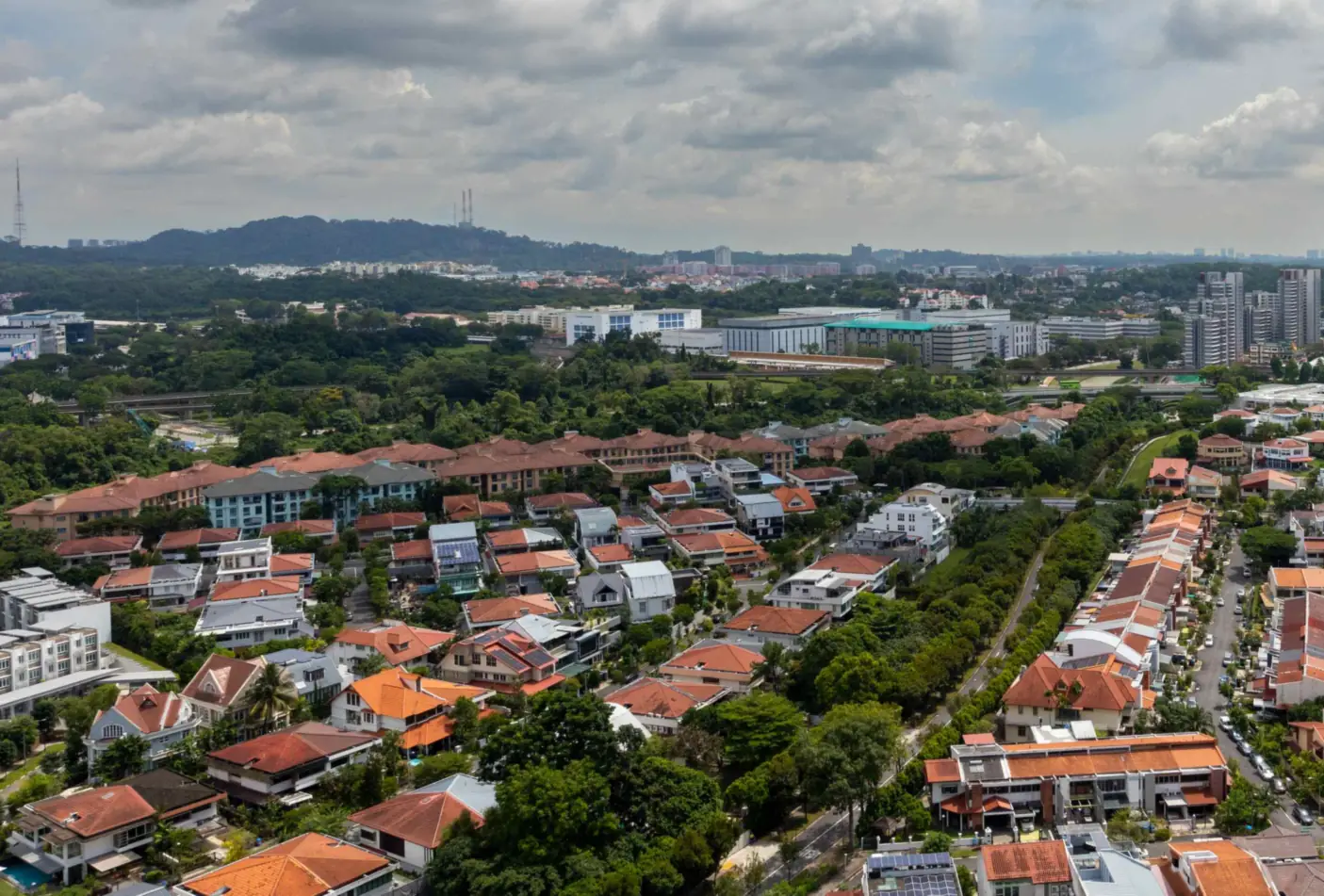
As EdgeProp Singapore reported on 26 October, landed home prices rose 3.7% in the third quarter to an average of $2,275 psf, excluding Good Class Bungalows and strata landed homes. The report drew on URA data compiled by Huttons Data Analytics, and it carried a second figure that I find more telling. The price gap between freehold or 999-year landed homes and 99-year homes widened to 51.2%. Lee Sze Teck, Huttons' senior director of data analytics, called it "the biggest since 2020".
From the street, a 99-year landed home and a freehold one can look much the same. Yet the market now prices them further apart than at any time since 2020. For a family that means to hold a landed home for the next generation, tenure is a larger part of what will be passed on. It is worth understanding before any decision to buy, sell or stay.
What did the third quarter actually show?
All three landed types rose. Semi-detached homes gained most, up 4.7% to $2,082 psf, even as sales fell 13.3% to 143 homes. Terraced homes rose 2.7% to $2,400 psf on 300 sales, and detached homes rose 1.4% to $2,046 psf on 44 sales. Huttons' reading was that "some buyers were priced out of the semi-detached market" and that "demand shifted towards terraced homes".
Two quieter movements sit beside that. The average plot sold shrank from 3,079 sq ft to 2,910 sq ft, which Huttons put down to rising land costs. And 99-year homes made up 15.6% of deals, up 2.4 percentage points and the highest share since the first quarter of 2025. I read these as one decision taken in two ways. Buyers who want a landed home are giving up some land, or some lease, to reach it.
One caution on scope. The Huttons figures exclude Good Class Bungalows and strata landed homes, and cover 487 deals. URA reported a 2.9% rise in landed prices, and EdgeProp reported 588 landed homes sold, neither with those exclusions stated. These are different measures of the same market, and they are best kept apart.
How wide is the gap, and has it been this wide before?
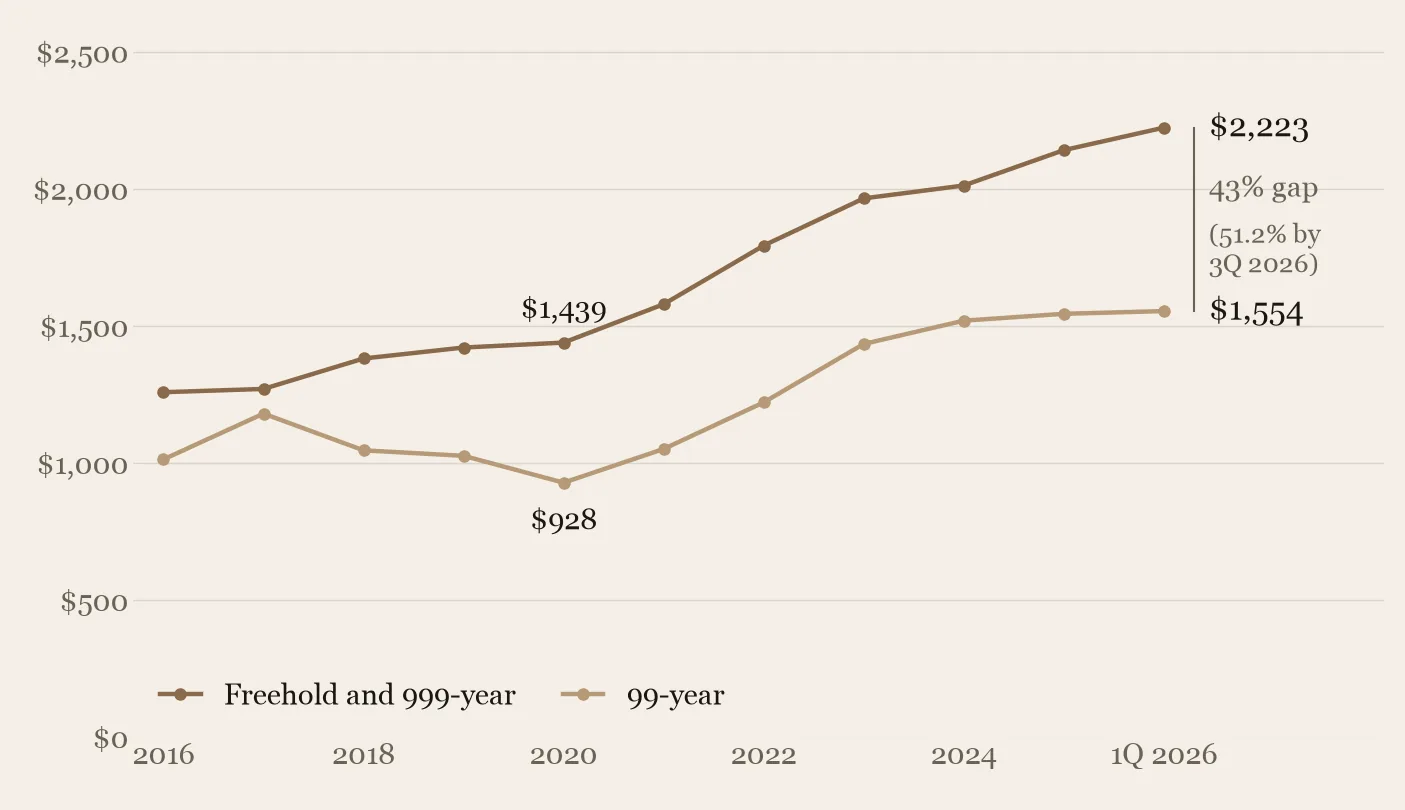
The gap has widened quickly. Huttons put it at 32.5% in 2024 and 38.6% in 2025, then at 43% in the first quarter of this year, as EdgeProp reported in May. In that quarter, freehold and 999-year homes averaged $2,223 psf, against $1,554 psf for 99-year homes. At 51.2%, the first group sells at about one and a half times the price per square foot of the second.
Most of that movement came from one side. Between 2024 and the first quarter of this year, the 99-year average went from $1,519 psf to $1,554 psf, while the freehold and 999-year average went from $2,012 psf to $2,223 psf. The 99-year home did not lose ground in dollars. It stood nearly still while the other moved on.
The gap has also been wider, and it has narrowed. In 2020 the two averages stood at $1,439 psf and $928 psf, a wider distance in proportion than today, and the gap then closed to 32.5% by 2024. So I would not treat this as a fixed condition, and I make no forecast from it. An average also compares only the homes that happened to sell, and those differ by estate, plot, age and condition. The 51.2% describes a market. It does not price any one home.
Mr Lee noted that landed volumes may "dip slightly" in the fourth quarter because of the year-end holidays. That is Huttons' view. What I would look at in the next reports is whether the gap holds at this width, and whether the 99-year share of deals keeps rising.
Why can two homes that look alike be priced so far apart?
Because a lease is a length of time, and a buyer is paying for that time. Freehold has no end date. A 99-year lease does, and under SLA's lease policy, the land and the buildings on it revert to the lessor when the lease expires. For a State lease, that is the State. Huttons counts 999-year homes with freehold ones, which seems fair to me. A term that long changes little for any family now living.
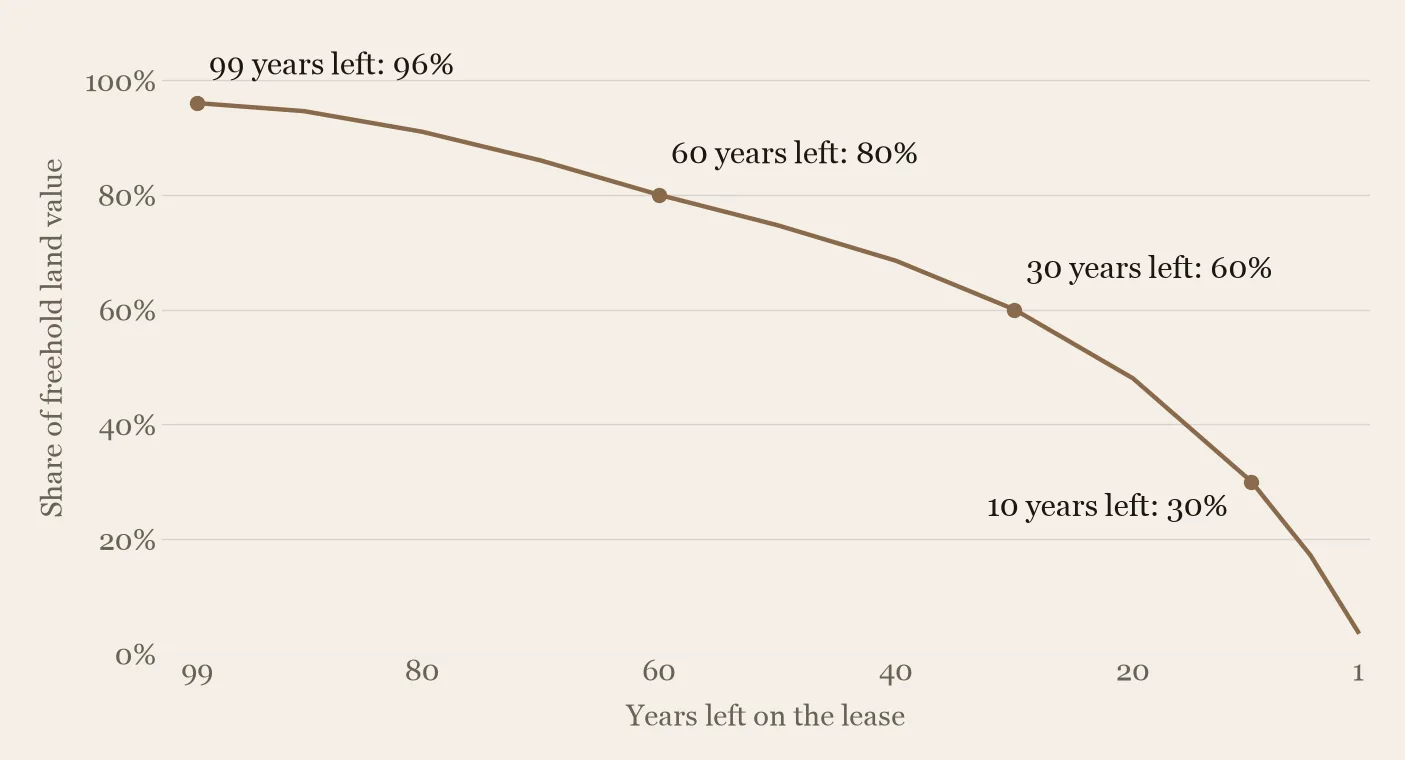
Singapore has an official way to express this. The Leasehold Table, reproduced in a 2022 circular from SLA and URA, gives the value of land as a share of its freehold value by the years left: 96% at 99 years, 80% at 60, 60% at 30 and 30% at 10. It values land, not the house on it, and the circular uses it to adjust a land charge, not to price a home. The Centre for Liveable Cities notes that it "is not an exact science". Its shape is still instructive. The fall is gentle at first and steep near the end.
So "99-year" is not one thing. The number that matters is the years left, and two homes can share the label while differing by decades. EdgeProp's May report gave a view of the far end: a terraced house off Upper Changi Road, on a 70-year lease from 1964 with about eight years left, sold for $400,000, or about $107 psf on its land. One sale proves little. It is still a reminder of how far a short lease can sit from the island's averages.
Nor should renewal be assumed. SLA states that, in general, "the Government's policy is to allow leases to expire without renewal". Renewal is considered case by case, and for residential use it may turn on matters such as more intensive use of the land. Where it is granted, the lessee pays a land premium. Landed owners have already met this. In 2017, the Minister for Law told Parliament that 191 private terrace houses at Lorong 3 Geylang, on 60-year leases, would return to the State when those leases expired on 31 December 2020.
What does tenure mean for the family that inherits the home?
This is where I think the headline matters most. A buyer pays for the lease as it stands today. A family inherits whatever is left of it. As an illustration only, a lease with 80 years left today would have 50 left three decades from now, and on the Leasehold Table the land would go from 91% to about 75% of its freehold value. The house may be loved and well kept through all of it. The years run regardless.
A freehold home passes on as it is. A 99-year home passes on with fewer years than it came with.
None of this makes a 99-year home a poor choice. It can offer a family more room for the same money, and the gap suggests its price already allows for the shorter term. For a family that plans to live in a home for a good many years and then move on, a long lease may do all that is asked of it. The question changes when the plan is for a child to hold the home, or for siblings to share its value.
The lease also reaches the next buyer. CPF's rules allow savings to be used on a home whose lease does not cover the youngest buyer to age 95, but only a pro-rated amount, and only if at least 20 years remain. So how a future buyer can pay may change as a lease shortens, which matters to a family who one day decides to sell. Freehold does not settle every question. It only takes this one away.
What should be in order, whichever the tenure?
Tenure shapes what is passed on. A few documents decide how it gets there, and they do different jobs.
- How the title is held. Under joint tenancy, the surviving owner takes the whole home, whether or not the other left a will. Under tenancy in common, each owner's share is separate and goes through the probate process.
- A will says who receives your estate. In an uncontested case, the executor named in a valid will generally applies to the court for a grant of probate. Without a valid will, a beneficiary generally applies for letters of administration.
- A lasting power of attorney appoints people you trust to decide for you if you lose mental capacity. Without one, your family must apply to court to become your deputy, which typically takes 6 to 12 months.
- A CPF nomination states who receives your CPF savings, though not investments made under the CPF Investment Scheme. Those savings sit outside your estate, and a will cannot cover them.
- A trust places assets with a trustee on set instructions. It can help to control and protect family assets, though MoneySense notes that recurring fees can make it costly.
This is a general description and not advice for any family. It is worth asking a lawyer or adviser if a home is held with someone other than a spouse, if children are to receive unequal shares, if a trust is under consideration, or if Faraid applies to your family.
For now, three plain questions seem to me worth more than the quarter's headline. How many years are left on the lease, exactly? What have homes of the same tenure fetched on your own street, rather than across the island? And who do you intend to hold this home next, and do the papers say so? None of these needs an answer this quarter. They are simply better asked early.
If this touches your own home
I am glad to talk it through. Property is my side of the table, and I work with Summit Planners, who draw up wills and lasting powers of attorney around the home under their own arrangements.
Start a conversationJessin Chua, CEA R066020B · Isaac Tan, CEA R071233B · PropNex Realty Pte Ltd, CEA L3008022J
Sources
- Higher demand for terraced homes as some buyers priced out of semi-detached segment: Huttons, EdgeProp Singapore, 2026-10-26
- Fewer landed homes sold in 1Q2026, but demand for detached houses lifts average deal size: Huttons, EdgeProp Singapore, 2026-05-04
- Private home prices up 1.4% while rents gain 1.3% in 3Q2026, speeding up slightly, EdgeProp Singapore, 2026-10-23
- Release of 3rd Quarter 2026 real estate statistics, Urban Redevelopment Authority, 2026-10-23
- Lease Policy, Singapore Land Authority, 2026-11-02
- Circular URA/PB/2022/08-DCG: Land Betterment Charge, Appendix 2, Table showing leasehold values as percentage of freehold value, Singapore Land Authority and Urban Redevelopment Authority, 2022-07-05
- Determining the value of leasehold land: A closer look at Bala's Table, Centre for Liveable Cities, 2017
- Written answer by Minister for Law to Parliamentary Question on Lorong 3 Geylang, Ministry of Law, 2017-07-04
- How much CPF savings can I use to buy a property if its lease does not cover the youngest buyer to age 95?, CPF Board, 2026-11-02
- How to secure your future with CPF nomination and LPA, CPF Board, 2026-11-02
- Why Make a Lasting Power of Attorney?, Ministry of Social and Family Development, 2026-11-02
- Probate and administration, Family Justice Courts, 2026-11-02
- Deciding how to transfer your estate, MoneySense, 2026-11-02
- Home Ownership, Majlis Ugama Islam Singapura, 2026-11-02
General information only, correct to my reading of these sources on the date above. Nothing here is financial, legal or tax advice, and none of it takes your circumstances into account. Photographs and charts in this note are credited where they appear.
Jessin Chua · PropNex Realty Pte Ltd · CEA Registration Number R066020B · CEA Licence Number L3008022J