CPF's 4% floor, and the savings a will cannot reach
Another year of certainty on CPF interest is a quiet reason to check who those savings would go to, and how that sits beside the home and the will.
By Jessin Chua
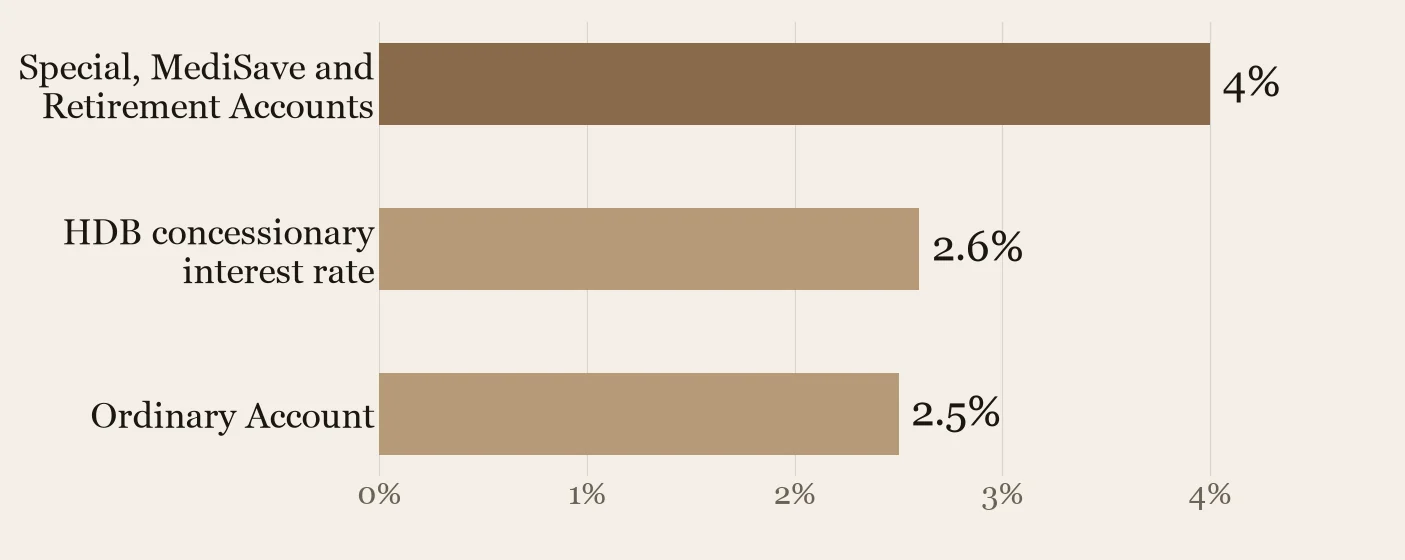
As CPF Board announced on 22 September, the Government has extended the 4% interest rate floor on Special, MediSave and Retirement Account monies for another year, from 1 January to 31 December 2027. The Board said the extension gives members certainty on their CPF returns amid an uncertain economic and interest rate environment.
It is modest news, and welcome news for anyone with savings in those accounts. I read it as a prompt for a different question. A family's home is the obvious subject of a will. Its CPF savings are not, and that is easy to forget. The rate is what was announced. The nomination is what I would look at.
What did the announcement actually change?
One date, in effect. The floor now runs to 31 December 2027. Today's rates did not move. From 1 October to 31 December 2026, Special, MediSave and Retirement Account monies earn 4% a year and the Ordinary Account earns 2.5%. The HDB concessionary interest rate, pegged at 0.1% above the Ordinary Account rate, stays at 2.6%. Members also earn extra interest on the first $60,000 of their combined balances, of which no more than $20,000 can come from the Ordinary Account.
The word floor is doing real work. The Special, MediSave and Retirement Account rate is pegged to the 12-month average yield of 10-year Singapore Government Securities plus 1%. That pegged rate remains below 4%, so the floor sets the rate rather than the peg. The Ordinary Account sits at its own floor of 2.5% for the same reason. Its rate is based on major local banks' interest rates, and CPF Board's rates page gives that average as 0.32% for May to July 2026.
These rates are reviewed each quarter. The extension sets a lower limit on the Special, MediSave and Retirement Account rate until the end of next year, and it says nothing about what follows. That is a useful certainty, though a narrow one. It speaks to what the savings earn. It does not speak to where they go.
Why can a will not reach CPF savings?
A will deals with your estate, and CPF savings do not form part of it. CPF Board says so plainly: the savings cannot be included in a will, and this protects them from creditor claims on any outstanding debts.
What governs them is a CPF nomination, which names who receives the savings and how much each person gets. It covers savings in the Ordinary, Special, MediSave and Retirement Accounts, the CPF LIFE premium balance and discounted Singtel shares. It needs two witnesses, who cannot themselves be nominees. Making one is free, and nominees pay no charges to claim. They also avoid probate, the court process a will goes through, which an article on CPF Board's site says typically takes three to six months.
Without a nomination, the savings pass to the Public Trustee's Office, which distributes them under the intestacy laws or, for a Muslim member, the Muslim Inheritance Certificate. That holds even if your wishes are stated clearly in your will. You cannot decide who receives the savings or how much. CPF Board says it can take up to six months for the Office to identify the eligible family members.
There is a fee as well. The Public Trustee's scale starts at 2.4% of the first $1,000 and steps down to 0.3% on amounts above $500,000, with a minimum of $15. The Office takes it from the CPF money, and it cannot be waived.
Who receives the savings if there is no nomination?
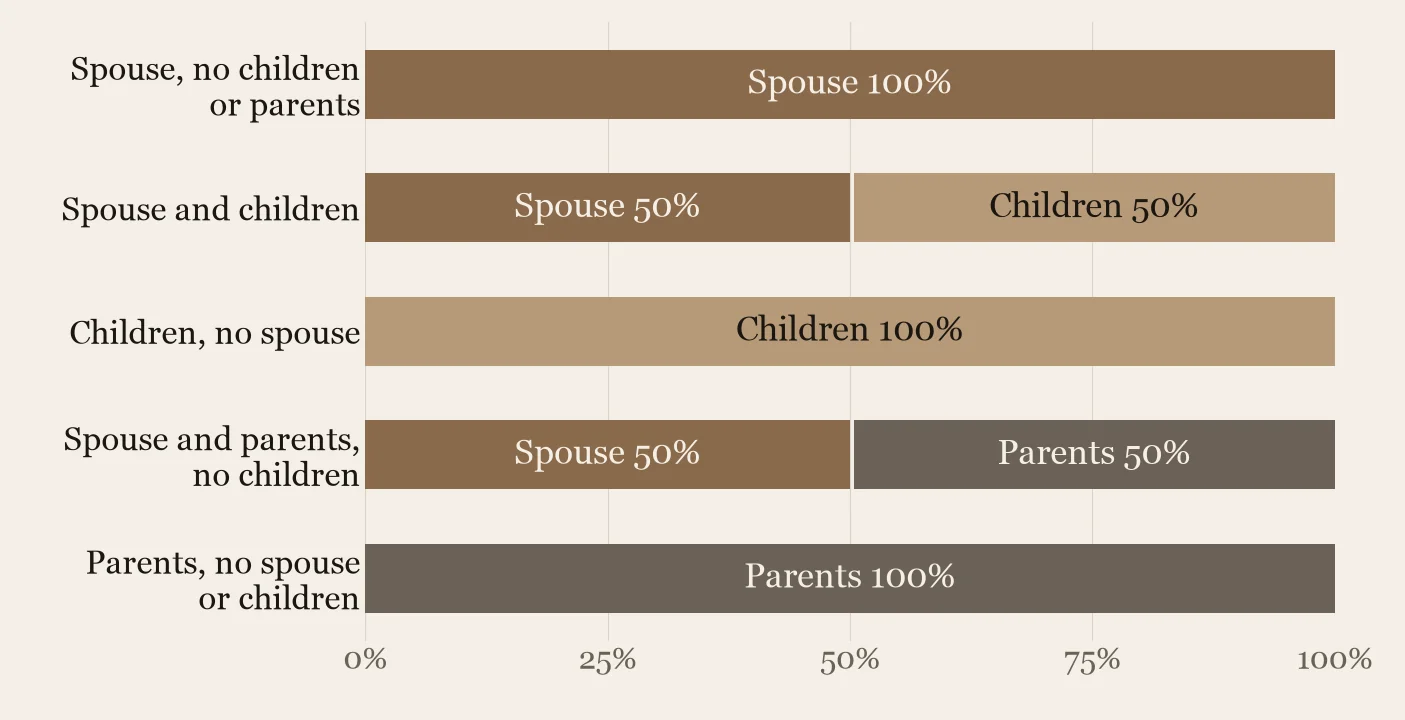
For a non-Muslim who dies domiciled in Singapore, the Public Trustee follows the rules of distribution in the Intestate Succession Act 1967. Where a person leaves a spouse but no children or parents, the spouse takes the whole share. A spouse and children take half each, and the children's half is shared equally among them, with a child's own children standing in if that child has already died. With no children, a spouse takes half and the surviving parents share the other half. Children with no spouse take the whole share, and parents are not entitled. If there is no spouse, child or parent, the line moves to siblings, with a sibling's own children standing in if that sibling has already died, then grandparents, then uncles and aunts.
For a Muslim, the money is distributed under Section 112 of the Administration of Muslim Law Act 1966. The Certificate of Inheritance issued by the Syariah Court lists the beneficiaries and their shares.
These rules are orderly, and for some families they may come close to what was intended. They were also written for no family in particular. A parent receives nothing where the person who died leaves children, even a parent who relied on that son or daughter. A brother or sister receives nothing while a spouse, child or parent survives. The Public Trustee also notes that illegitimate children and transferred children are not entitled under these rules.
A rule can be fair and still not be what you meant.
Where does the home sit in all this?
Outside the nomination altogether. CPF Board is clear that a home bought with CPF savings is not covered by a CPF nomination. What happens to it depends on how it is held. A home in sole ownership forms part of the estate and follows the will. Under joint tenancy, ownership passes to the surviving owner or owners, with no need for a will. Under tenancy-in-common, the owner's share goes to the estate and follows the will. Where there is no will, the estate is distributed under the intestacy laws or, for Muslims, an inheritance certificate.
So one family can have three arrangements at work: the way the home is held, the will, and the nomination. Each may have been settled on a different day, years apart, by a family that has since changed. None of them reads the others. A will can divide a home with great care while an old nomination sends the CPF savings somewhere else. A joint tenancy can carry the home to the surviving owner with no will involved at all.
That is the part I would want a family to see. How a home is held is worth discussing with a lawyer, and so is any structure beyond the simple forms above. I would ask sooner where there are children from more than one marriage, a dependant who may need care for many years, or a home held with someone other than a spouse. The law here turns on detail, and an adviser can see what an article cannot.
What is worth checking, and when?
CPF Board suggests reviewing a nomination at least once a year, or after a major life change. Your nomination details can be viewed online with Singpass, though one made more than 30 years ago will not show them. The questions are simple.
- Is there a nomination at all? If there is none, everything above applies.
- Has there been a marriage since? Marriage revokes an existing nomination. Divorce does not, so a former spouse may still be named.
- Has a child been born since? The article on CPF Board's site recounts a case shared at a CPF Board festival. Three sons survived their father, and the youngest was left out of the nomination. It had been made before he was born.
- Has a nominee died? CPF Board says that nominee's share is reallocated to the surviving nominees, which may not be the balance you would choose.
- Is a nominee under 18? CPF Board's guide says the money is held in trust by the Public Trustee until the nominee turns 18. The Public Trustee charges fees for holding it.
Two things sit outside the nomination besides the home. Payouts from the Dependants' Protection Scheme have a nomination of their own. Investments under the CPF Investment Scheme, and any cash in the Investment Account, form part of the estate, apart from insurance policies with their own insurance nomination.
One more document answers a different question. A will and a nomination take effect on death. A Lasting Power of Attorney looks to the years before it. It lets a person aged at least 21 appoint one or more donees to make decisions and act for them if they lose mental capacity one day, in personal welfare, property and affairs, or both. For a family whose wealth sits largely in its home, I think the second of those deserves some thought.
None of this needs hurrying. The floor is settled until the end of 2027, and a new nomination replaces the old one. I would simply set the three side by side, the way the home is held, the will and the nomination, and read them as one. If they say what you mean, nothing need change. If they do not, that is the time for a lawyer or an adviser, and for a longer conversation at home.
If this touches your own home
I am glad to talk it through. Property is my side of the table, and I work with Summit Planners, who draw up wills and lasting powers of attorney around the home under their own arrangements.
Start a conversationJessin Chua, CEA R066020B · Isaac Tan, CEA R071233B · PropNex Realty Pte Ltd, CEA L3008022J
Sources
- Government extends 4% interest rate floor on Special, MediSave and Retirement Account monies until 31 December 2027, CPF Board, 2026-09-22
- CPF interest rates, CPF Board, 2026-09-15
- Make a CPF nomination, CPF Board, 2026-05-25
- What does your CPF nomination cover?, CPF Board, 2025-05-30
- How to secure your future with CPF nomination & LPA, CPF Board, from SG Budget Babe, 2024-06-13
- CPF Nomination: A guide to planning the distribution of your CPF savings, CPF Board, 2023-06
- CPF Money: Standard Claim, Public Trustee's Office, Ministry of Law, 2026-10-30
- What is a Lasting Power of Attorney, Office of the Public Guardian, Ministry of Social and Family Development, 2026-11-02
General information only, correct to my reading of these sources on the date above. Nothing here is financial, legal or tax advice, and none of it takes your circumstances into account. Photographs and charts in this note are credited where they appear.
Jessin Chua · PropNex Realty Pte Ltd · CEA Registration Number R066020B · CEA Licence Number L3008022J